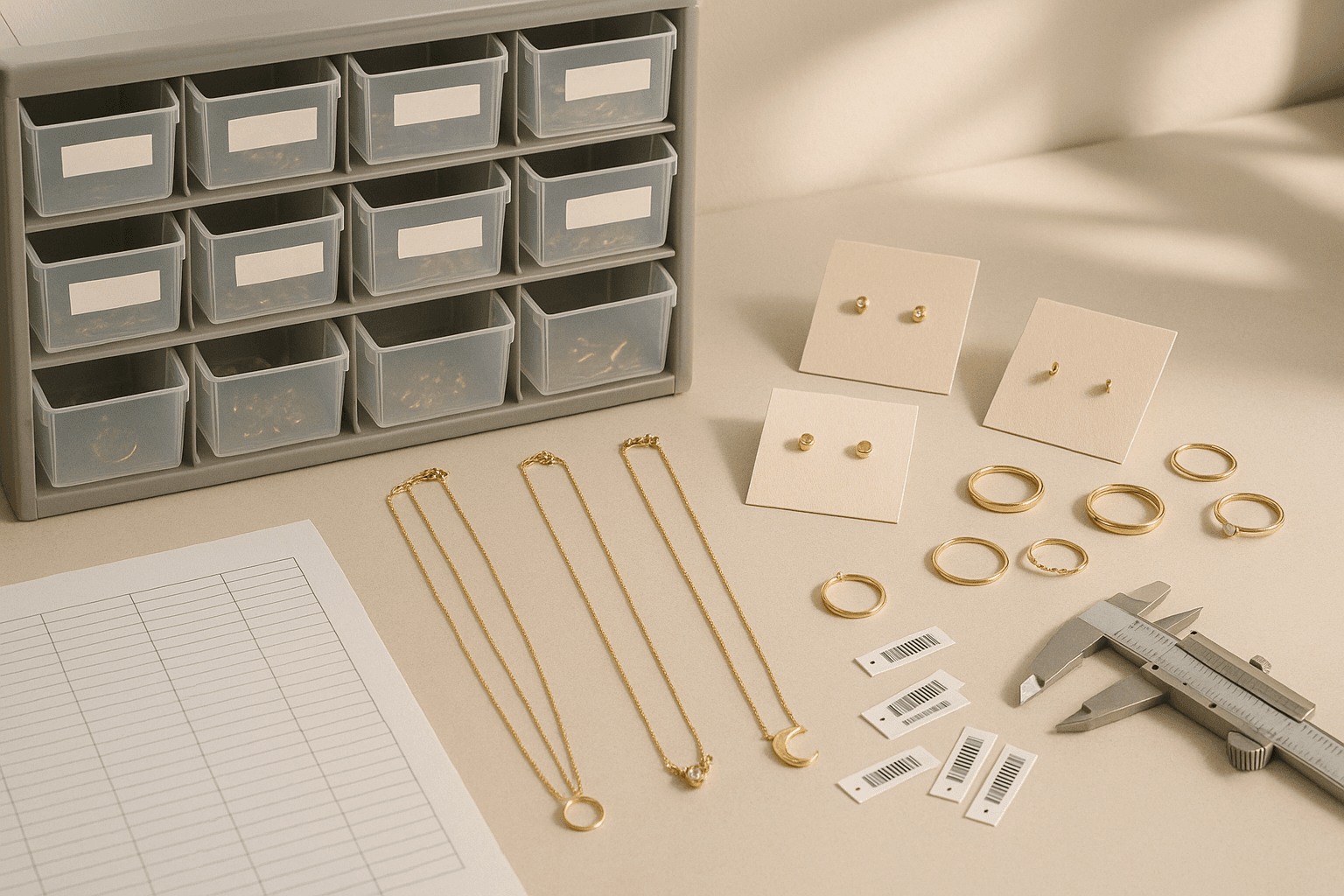
Jewelry inventory is one of the easiest parts of a jewelry business to underestimate and one of the fastest places to lose money if you ignore it. When you are just starting, it is tempting to keep everything in your head or on a few notes in your phone. That can work for a handful of styles, but once you have multiple metals, sizes, finishes, and packaging options, you need a system that tells you what is in stock, what is selling, and what needs to be reordered. A good inventory setup is not about being fancy; it is about reducing mistakes and making your next decision easier than the last one. It also supports smarter pricing, because your real costs only stay visible when stock is tracked consistently. For founders still building the basics, the broader setup process in How to Start a Jewelry Business From the First Product to First Sale can help you see where inventory fits into the full business workflow.
The first step is to decide what exactly counts as an inventory item in your business. In jewelry, that can include finished pieces, components, packaging, replacement parts, displays, and even gift boxes if they affect order fulfillment. Too many founders only track finished products and then wonder why they are always short on jump rings, earring backs, or ring boxes right before a market. Write down every item that must be on hand for you to make, package, or ship a saleable product. Then group those items into clear categories such as ready-to-sell goods, build-to-order materials, and consumables. This makes your counts more accurate and helps you see which part of the business is actually tying up cash. If a component is used in multiple products, treat it as a separate stock item so you can forecast demand instead of guessing.
Once you know what you are tracking, the next job is building a naming and SKU system that makes sense to you and to anyone who might help you later. A SKU should not be cute; it should be descriptive, short, and consistent. For example, a necklace might have a code for collection, metal finish, chain length, and stone color. That sounds detailed, but it saves time when you are filling orders or checking stock across a website, a market table, and a wholesale line sheet. The goal is to make one item impossible to confuse with another. You do not need enterprise software to start, but you do need one source of truth. A spreadsheet can work well at the beginning if it includes SKU, item name, location, cost, retail price, quantity on hand, and reorder note. If pricing is still changing as you learn your costs, it may help to revisit Pricing Handmade Jewelry for Profit Without Guesswork so your inventory records and pricing logic stay aligned.
A clean inventory system also starts with sensible product architecture. That means fewer unnecessary variations and more intentional collections. If every item comes in six finishes, four chain lengths, and three stone options, your inventory can become unmanageable very quickly. Small jewelry businesses often do better when they limit the number of variables early on and expand only after they know which combinations actually sell. This is not just about efficiency; it is about understanding demand. If one finish is responsible for most sales, your reorder decisions should reflect that instead of treating all variants equally. A narrower assortment also makes counting easier, photo organization cleaner, and customer service simpler when someone asks whether a certain option is in stock. The fewer places your inventory can hide, the easier it is to keep your business accurate.
Physical organization matters just as much as digital tracking. Every item should have a home, and that home should not change unless you update your system. Store finished jewelry separately from raw materials, and separate fast-moving pieces from seasonal or limited-run items. Label bins, drawers, and shelves in a way that matches your SKUs or product groups so you can find items quickly during packing and counting. If you make pieces by hand, create a small production staging area where partially completed orders do not get mixed with finished stock. This prevents the common problem of counting a necklace twice or shipping a piece that still needs a final inspection. Good organization also makes it easier to train a helper, because the system is visual instead of being stuck in your memory. The cleaner your storage, the faster your business becomes without adding stress.
Reorder planning is where inventory turns from recordkeeping into cash-flow management. You do not want to reorder too late and miss sales, but you also do not want to overbuy and lock money into slow stock. The simplest approach is to set a reorder point for every important item. That point should reflect how long it takes you to get more stock, how quickly the item sells, and whether you need extra buffer for markets or seasonal demand. If your supplier takes two weeks and a piece usually sells through quickly, your reorder point needs enough cushion to cover those two weeks plus a little extra. For many small brands, it helps to review the top-selling SKUs weekly and everything else monthly. If your business is still at the planning stage, the SBA's 10 steps to start your business is a useful reminder that operational systems matter just as much as creative vision.

Real brand story: Mejuri is often discussed as a direct-to-consumer jewelry brand that pairs frequent product drops with strong material education. The practical lesson for smaller founders is not to copy scale, but to copy discipline. When customers know what a piece is made of, how it is meant to be worn, and when it is available, inventory becomes part of the customer experience instead of just back-office admin. That is especially important in jewelry, where small details like metal type, gemstone size, or clasp style can affect both demand and reorder timing. If you track stock but do not track which product details matter to buyers, you will miss the chance to learn what to replenish and what to phase out. Inventory should tell a story about demand, not just a count on a screen.
One of the most overlooked parts of jewelry inventory is the difference between sell-through and profitability. An item can sell well and still be a poor use of inventory if it ties up too much money, takes too long to make, or has a high rate of returns or repairs. That is why your inventory records should connect to margin, not just quantity. Track the true cost of each style, including packaging, labor, and any special parts that are hard to replace. Then compare those costs against how often the item moves. The pieces that sell quickly and reliably deserve more replenishment attention than the pieces that look beautiful but sit for months. If you want a deeper operational reminder on how product decisions affect income, the FTC’s jewelry business guidance is a helpful place to review claims, material descriptions, and business practices that affect customer trust.
Your inventory system should also support your marketing and content decisions, not just your warehouse habits. When you know which products sell fastest, which ones are seasonal, and which pieces get frequent questions, you can plan launches, email campaigns, and social content around real demand. For example, if a certain chain style gets repeated customer questions, that tells you it may need a better product description or a comparison photo. If a specific ring size sells out fastest, that informs both your restock schedule and your ad budget. Inventory data is one of the best tools for making marketing more grounded. Google’s SEO Starter Guide is useful here because it reinforces a simple idea: content should help people find what they need. In jewelry, the same rule applies to inventory; the right product needs to be available when the right customer is searching for it.
For founders who sell at markets or pop-ups, inventory discipline becomes even more important because you are moving stock between locations. A market table can empty out your best sellers in one afternoon, and if that sell-through is not logged promptly, your website may show items that are already gone. Build a simple transfer process before every event: what is leaving the studio, what is coming back, what sold, what was damaged, and what needs to be restocked. After the event, reconcile your physical count with your digital count the same day if possible. This is not busywork; it is what keeps your business from promising products you cannot deliver. The best market sellers are often the products that teach you how to improve assortment planning, because they show real customer behavior without the delay of online analytics.
Action points: this week, pick your top 20 jewelry items and give each one a clean SKU, a quantity on hand, and a reorder note. Then create one master spreadsheet or inventory app view that includes finished goods, components, and packaging. Next, choose a storage system that matches those SKUs and label every bin or drawer so you can find items without guessing. Finally, review one month of sales and mark which pieces sell fastest, which pieces often run out, and which pieces should be discontinued or reordered more cautiously. If you need a practical next step after stock control, reading a broader framework like A Simple Marketing Plan for a Jewelry Brand can help you turn your best inventory into a more intentional sales plan.
A strong jewelry inventory system is not about having perfect software or a huge catalog. It is about making your business easier to run, easier to restock, and easier to trust. When you know what you have, where it lives, how fast it moves, and what it costs, you can make better decisions about pricing, promotion, and production without reacting to every surprise. That is especially valuable for small jewelry brands, where time and cash are limited and every misplaced item creates extra work. If you treat inventory as a core operating system rather than a side task, your business becomes calmer and more scalable at the same time. That kind of control does not just protect sales; it protects your creative energy, which is often the most important resource you have.
Before you expand your assortment, it is worth asking one more question: does this new product fit the inventory system you already have, or will it create avoidable complexity? Many jewelry founders grow too fast by adding styles before they have a reliable process for counting, reordering, and storing the originals. A better approach is to let the inventory system set the pace. If your current setup can handle the extra volume cleanly, then expansion makes sense. If it cannot, fix the process first and launch the new product later. That sequence is slower in the short term but much healthier in the long term. The jewelry businesses that stay organized are usually not the ones with the most products; they are the ones that know how to manage the products they already have.